
Why the Caribbean?
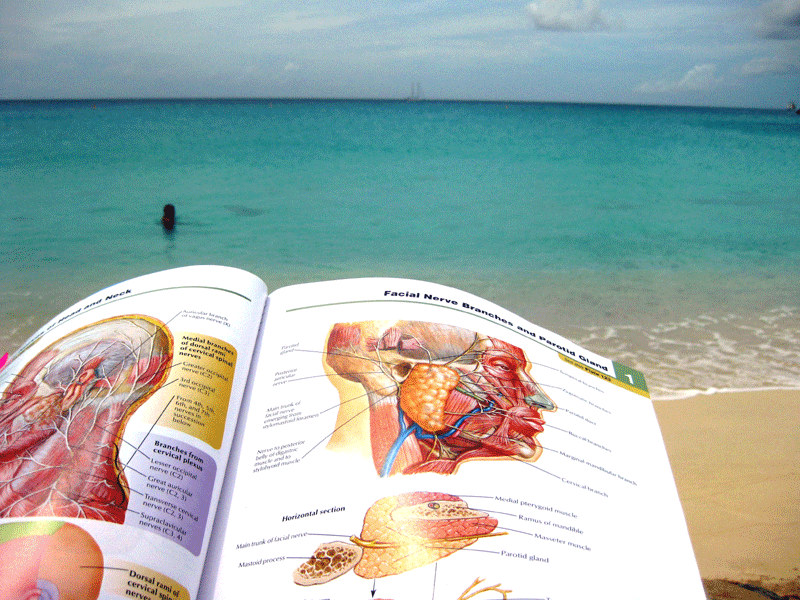 When I tell people that I am going to the Caribbean for medical school, the most common response I get is how jealous they are that I will get to spend the next few years in a place as relaxing as a tropical paradise. While I don’t think medical school will be relaxing at all, I can’t deny that the Caribbean is a beautiful place to study, and warm all year round. If I get tired studying for hours and hours straight, I can just step outside and watch a beautiful sunset on the beach… how can I say no to that?
I can also learn a lot about myself and others by living in another country, studying with fellow students and faculty together in an academic environment. Experiencing what it’s like to be a guest in another’s country and adjusting to life in a different culture can make me into a stronger individual, and a more open-minded doctor, with a fascinating story to tell.
But most importantly, coming to the Caribbean is a chance for those of us like me who for whatever reason did not secure a spot in a US medical school, but still have lots of passion to pursue medicine and are committed to work hard to achieve our goals. For students who do not get into a US med school by April, Caribbean schools offer a chance to start med school in the fall without needing to wait another year to reapply. The application process is much faster than that of US med schools. For the schools I applied to in the Caribbean, I found out whether or not they wanted to give me an interview within two weeks of submitting my application, and whether or not I was accepted 1-2 weeks after the interview. For the American University of the Caribbean (AUC), I applied in the summer, and got in for the fall. As a post-bacc student who already has a degree, I cannot afford to wait another year.
Caribbean medical schools offer a chance for many people because they are generally less difficult to get into. In the U.S., it is not uncommon for a med school to have 11,000 applicants apply to fill 190 spots (New York Medical College 2008-09). This is due to the disproportionate high number of premed students in comparison to the low number of seats available in the United States. As there are three entering semesters per year at most Caribbean med schools, more spots are available to be filled at these schools. And as there are less American applicants who consider traveling abroad for med school, there is less competition for spots for applicants in these schools. In Spring 2009, 1,663 applicants competed for 422 seats at St. George’s University (SGU) School of Medicine on the island of Grenada. The admissions requirements are usually easier to fulfill for Caribbean schools. For example, at New York Medical College, matriculants have an average score of 30 MCAT and 3.5 GPA, whereas at SGU, it is 26 MCAT and 3.3 GPA.
However, there are many educational advantages at the top Caribbean medical schools (AUC, SGU, Ross, Saba). Unlike US medical schools where professors are obligated to put in time for their own research and medical practice, in Caribbean schools, professors are dedicated (and paid) to teach. That is their primary job. Because of this, they have much more time to prepare lectures and to help students.
The only concern I have for Americans considering applying to the Caribbean for medical schools is to make sure you do your research! There are around 30 offshore medical schools in the Caribbean and not all are accredited or able to produce graduates who can practice in all 50 states. In fact, as of 2019, the only six medical schools in the Caribbean that are considered by the United States Department of Education to be comparable to U.S. medical schools, approved for graduates to practice in all 50 states, and meet the rigorous requirements to offer U.S. federal financial aid are American University of the Caribbean (AUC), Ross University, Saba University, and St. George’s University, Medical University of the Americas (MUA), and American University of Antigua (AUA). Their students are therefore able to do anything U.S. medical students can do: receive U.S. federal loans, participate in the National Residency Matching Program, and be licensed in all 50 states. Check out my post about how Caribbean med schools get accredited!
When people think of the Caribbean, they normally would not think of med schools. But with a chance for personal development, faster application process, less competition for seating, the same great education and opportunities as their U.S. counterparts, and of course beautiful beaches, the top Caribbean medical schools give aspiring physicians like myself a great opportunity to pursue their dreams.



Benji,
I have been reading your blog ever since I decided to apply to AUC this winter. I’m currently a volunteer at an orphanage in Guatemala, where I work in the clinic at the home. As you know, applying to medical school is diffuclt enought, I also decided to add more pressure by applying while doing a year of service in a foriegn country. I was accepted to the Fall 2011 class in January, and have recently decided to attend AUC in the Fall.
I guess, I just wanted to say, “Thank you”, your blog really helped me in my decision, and help calm down some of my fears about attending a foriegn medical school. I am sure that you have probably heard this before, but your blog was by far the best resource I found when it came for information about Caribbean medical schools.
Thanks again,
Michael
Benji,
Yes, I agree..thank you so much for taking the time to do this blog. It has been very helpful to say the least. Really appreciate your time and effort.
Ted Bowersox
I would like to know about transferring from Caribbean medical schools to the USA.also i would like to know about the visiting students option to good medical schools and hospitals in the USA for clinical rotations.
Hi Elijah,
Occasionally, you do hear of a student transferring from the Caribbean to the US, but it is rare. There are only a few schools in the US that allows such transfers, like SUNY Downstate. They are very selective and you have to be among the top students at AUC and have an amazing Step score to be considered. Students who transfer usually do so after Basic Sciences and before clinical rotations. As for rotations, you can certainly do elective rotations at hospitals not affiliated at the school, but you’d have to apply and set it up yourself, then run it by AUC to see if they approve. The hospitals must be ACGME-approved (green-book) Not all non-affiliated teaching hospitals accept Caribbean medical students as visiting students, so you must inquire if they do. AUC has a list of affiliated and non-affiliated hospitals on their website that shows all the hospitals that previous students have managed to schedule electives at. Check it out. Hope this helps and good luck!
Benji
I am thinking about going to windsor medical school. good?
Depends on what your goals are. If your goal is to practice medicine in California, for example, then Windsor may not be the ideal school to go to, as it is not approved in that state. Make sure to read about accreditation before going to any school. Otherwise, the school is an opportunity for many students to become a doctor, as long as you work hard and focus. Best of luck!
Affordable? You left out St. George’s — $50+ per year as the total tuition is 200,000+, higher than the tuition of Harvard’s medical school
Thanks Sasha for your input. Yes, you are right in that Caribbean schools nowadays are no longer affordable. They were once considered generally affordable, but tuition has increased at quite a fast rate every year recently. I wrote this post in 2009, and the numbers quoted on my post were the numbers from the websites of the schools at the time.
Why did you not apply to US MD schools? or even DO schools. Also if you have finished med school, shouldn’t you have matched by now?
Hi Mike,
Thanks for visiting my blog. I did apply to US schools but did not get in. I did not originally intend to go to medical school in the Caribbean. I don’t think anyone does. However, it is what happened, and I’ve gained more than what I ever thought I could, academically, and personally. Feel free to check out my post on why I ended up in the Caribbean: http://www.caribbeanmedstudent.com/2009/07/why-am-i-a-caribbean-med-student/
Also, to match and start residency in July of a certain year, one must graduate by May of that year. I finished my coursework in August and graduated in October, and therefore although I have graduated, I will match and start residency the following July. Hope that answered your question.
Benji
Hi
I am an FMG wondering if there are residency programs in CMU and what are the requirements for matching.. plz reply..
Hi Amritha,
I would recommend you reading this post first about the timeline for medical school and residency: http://www.caribbeanmedstudent.com/med-school-timeline/ . If by CMU you mean Caribbean Medical University, they don’t have a residency program, since they don’t have a hospital, and they are not in the US. In order to match, you must pass Step 1 and 2 before match day. The residency program must be in the Graduate Medical Education (GME, “green book”) directory. If you want to go through the match, you need to apply through ERAS. As an FMG, you can also pre-match at a green book program that offers it. Best of luck.
Benji
Hey,
I’m thinking about applying to UNIBE in DR. They make you take Step 1 before clinicals and have some affiliations with hospitals in the US. Do you think that it will be a good idea?
Hi Guillermo,
I’m not too familiar with UNIBE, so I may not be the best person to ask about the experience there. From what I understand, they have an English program and students who are US citizens are able to get US federal student loans. However, UNIBE is not approved in California, and so graduates cannot practice in California any of the states that follow California’s list. This was an important reason why I didn’t apply to UNIBE, and instead looked into AUC, SGU, and Ross. Taking Step 1 before clinicals is pretty standard in off-shore medical schools in the Caribbean. Best of luck!
Benji
Hello Benji! I have been your fan for the last year. You truly became my inspiration. I revisited my life choices and decided to go to med school. Hope you can answer a few soar questions for me. What are the chances for a person who graduated from college in 1999( do they accept old people)? What is a good way to study for MCAT for someone who has been out of school for that long? Is it possible to take classes in a way that you complete your studies in AUC in 4 semesters instead of 5? Is it possible to take summer semester off so that you can go home and earn some money to leave it for family? I will be very grateful for your guidance.
Hi Lani, thank you for reading my blog! There are certainly many students who are older here. Definitely there are many students in their 30s here. I also have several classmates who graduated college long before you who are in their 40s and even 50s. Many of my older classmates do very well in school because of the discipline and determination they gain from having more life experiences.
As for MCAT, you could consider taking a prep course, like with Kaplan, as these give you a good overview of the material you need to perform well on the MCAT.
The curriculum for Basic Sciences at AUC is standardized and laid out in 5 semesters and so it would not be possible to complete them in 4. The amount of material you will be learning for medical school is quite a lot, and it would be difficult to learn it all in 4, or even 5. Some people may fail and have to repeat courses, or even withdraw from courses and take them later, and may stay on the island for 6, or even 7, semesters because of this. 7 is the maximum amount of semesters the school will allow you to stay before being dismissed.
When you start at AUC, the five semesters of Basic Sciences are meant to be taken in continuous order, and you are expected to finish Basic Sciences with your class. It is not common to take a semester off, and if you do, it would be considered a leave of absence by the school and the residency programs you apply to in the future. Leave of Absences do not look good on your applications when it comes time to apply for residency programs, and you would have to explain it to the programs. However, you could take out more federal student loans to help support your dependents. Many students with families do that.
Best of luck!
Benji
Hi Benji,
I am also planning on getting into one the caribbean school and found a medical school called AUA (American University of Antigua). I know this school is pretty new. Do you know anything about this school?
Thank you.
Hi Katherine,
Yes, AUA is relatively new, having only been in operation since 2004. However, it has grown quickly to become one of the major off-shore Caribbean medical schools. As of 2014, it is California approved, meaning graduates can practice in California and the many other states that follow California’s approved med schools list. Getting the California Medical Board’s approval is not an easy feat, and so this is a big achievement for AUA, and reflects the level of education that they offer.
However, since AUA is so new, graduates cannot yet practice in Kansas, which require the school to be at least 15 years old (which AUA will be in 2019). Therefore, AUA graduates may practice in all states except Kansas for now. However, it’s already 2014, and so if you were to go to AUA this year and graduate in 2018, and then do 3 years of residency in some other state, by the time you return to Kansas, it will be 2021, and you should be able to practice in Kansas then.
I personally know several graduates of AUA who are doing very well in residency, and so I know the school offers opportunities for those who strive to work hard. However, as of today, AUA does not yet offer US federal student loans, and so students will have to take out private loans with hefty interest rates and satisfy strict criteria.
The AUA campus is pretty new, and nice, from what I see from pictures. I’ve never visited campus before though, so I cannot say much about it.
If you haven’t already, please read my post on the accreditation process of Caribbean medical schools. It’s a long post, but very important and a must-read for all those considering the Caribbean: http://www.caribbeanmedstudent.com/2009/09/the-accreditation-process-of-caribbean-medical-schools/
All the best to you on school searching! 🙂
Benji
Hello Benji
I have read your blog and found it contains very useful information. Congratulations.
My question is : Do you know what is the procedure for a University in Dominican Republic to be recognized by WHO? or would you be able to point me in the right direction.
Any information you can give me would be great
Luz Maria Ortiz
Hi Luz,
Please read this post: http://www.caribbeanmedstudent.com/2009/09/the-accreditation-process-of-caribbean-medical-schools/
Thanks!
Benji
Hi Benji,
Thank you so much for your blog, I am a fan.
So I got into both ROSS and SGU ( didn’t know about AUC until I started reading your blog) for this upcoming fall. Since I did bad on my MCAT I didn’t apply to US schools last summer. Now I was thinking of retaking the MCAT. Now I wanted to know what you personally thing about going to the Caribbean now versus retaking and MCAT and see what happen. Do you think it’s worth the wait? or just go and start this September?
Thank you very much
Hi Amy, thanks for reading my blog, and congratulations on your acceptance to medical school. Coming to the Caribbean should always be a back-up choice if you didn’t get into a US school, and I wish you had applied to see if you could’ve gotten in somewhere. Although you can get a good education at AUC, Ross, or SGU, getting a residency can be more difficult than if you graduated from a US school. Typically, you’ll have to apply to at least twice as many programs and score higher than your US counterparts to be competitive for residency programs, and even then, the Match rate isn’t nearly as high as US schools. US schools typically have a Match rate of high 90s percent. The top Caribbean med schools has Match rates in the 80s percent. You’ll have to consider what is important for you and weigh your chances. How confident are you that you will score higher on the MCAT? And even if you score higher, acceptance to a US school is not guaranteed. A lot of times, there just simply aren’t enough spots for all those who are otherwise qualified. I have many classmates at AUC that score higher than 31, the average US matriculant score. I have classmates that score 35, 36, and even a 40 and still not get into a US school for whatever reason. I know people who scored the same as me on the MCAT with same GPA that get into US allopathic schools while I did not. Going through the application process myself, I realized that nothing is guaranteed. There are only probabilities and risks. If you want to pursue primary care specialties (considered less competitive) like family medicine, internal medicine, or pediatrics, and don’t care about getting into big-name residency programs, then SGU, Ross, AUC would be safe choices if you did not want to wait another year for another US application cycle with no guarantees of even getting accepted. If you do care about big-name residency programs, or want to do dermatology, ophthalmology, radiology, orthopedics, or other very competitive specialties, then coming to the Caribbean will be risky (not impossible, but risky). I’m not sure if I answered your question but I hope you’ll figure out what’s the best and safest choice for you. Best of luck!
Hi, I’m also having trouble deciding because I don’t want to waste more time than I already have. The main reason I want to go to the carribbean is due to the fact I can start school soon, and I’m okay being a primary care physician. I’m pretty good with my study habits. Had a low GPA freshmen year, but got it up to a 3.5 and have a 38 MCAT. I just wanted another opinion. Thankyou.
Hi Jahnavi, with an MCAT and GPA like yours, I would definitely shoot for a US medical school. It is much less risky in terms of matching. Plus, your decision in going into primary care may change while in medical school. During your rotations, you may discover that you don’t like the primary care specialties at all, but you absolutely love dermatology or orthopedics, in which case you would be better off coming from a US medical school. Best of luck!
Benji
Hi Benji! I just found your blog and have enjoyed reading your posts! I recently applied to Ross and just got my rejection letter today 🙁 I know my GPA and MCAT are low but I thought I had a chance of getting into Ross. I was thinking of applying to SGU and AUC but after being rejected from Ross, I am thinking that if I didn’t have a chance with Ross then I for sure won’t have a chance with those two schools. I just found out about Saba and AUA and am thinking of trying for those two because I read they are a little easier to get into than the rest, do you know if this is correct? I live in California and would like to practice here so AUA is not an issue with the whole Kansas thing. And if I don’t get into any of these schools, what other options do I have? I was confident before but after getting the rejection letter from Ross today, I am obviously bummed out and second guessing myself since I don’t really have a plan on what to do with my life if medical school isn’t in the cards for me. Any advice you can give me would be greatly appreciated.
-Michelle
Hi Michelle,
Sorry that you didn’t get good news from Ross. I would suggest you still go ahead and apply to SGU, AUC, Saba, and AUA. If you don’t apply, you’ll never know if you’ll get it. Admissions is kind of strange. I know some people who were rejected from AUC but got into SGU, and I know some people who got rejected from AUC and Saba but got into SGU. Apply and see! If these five schools don’t work out, I would retake the MCAT or find some way to improve your application and try again. If you really want to stay and practice in California, I would not recommend applying to any other school. Best of luck!
Benji
Hi Benji,
I just had an interview with AUC today and was told I should hear back from someone in two to three weeks. My question is why do you say a Caribbean medical school should always be a back up choice? Are there no students at AUC who chose to go there? Or who chose AUC or another Caribbean school over a US school? I have a 3.67 gap and a 32 MCAT score but one of the main things that attracted me to AUC is the opportunity to do clinical rotations in the UK. I believe an experience like that is not available in US med schools and I was told in my interview today that that looks really good on residency applications. Am I wrong in my thinking or is that a good enough reason to choose AUC over a US school if I get accepted?
BTW I also applied to about 16 US med schools both allopathic and osteopathic but have not gotten an II from any but AUC and Ross so far.
Hi Jessica,
Congrats on your interview invitation to AUC and I hope it went well! Your question has a great point. The education and experience at AUC does have many attractive features, like the opportunity to rotate in the UK. However, because AUC is an international medical school, there will also be limitations and challenges along the way. For starters, in your fourth year, you may decide that you want to do an elective as a visiting student at a certain hospital you really want to do residency in, to make connections with the program and get a better feel for the hospital, in hopes that this would boost your chance to match at that program. However, many hospitals may not even allow international medical students to rotate as visiting students at their hospital, whereas this would be easy to set up if you were at a US medical school. Also, as unfair as it is, many residency programs also simply do not accept international medical graduates into their program.
Depending on where you want to practice, some states are less IMG friendly than other states. Some states like Colorado accepts 313 US medical graduates into residency programs, but only 9 international medical graduates the same year. You can read more about the IMG-friendliness of states here: http://www.caribbeanmedstudent.com/2014/02/which-states-are-most-img-friendly/
Also, for whatever reason, international medical graduates also on average have to apply to much more programs to get the same amount of programs as US medical graduates do. I talk about this in this article: http://www.caribbeanmedstudent.com/2014/03/how-many-residency-programs-should-i-apply-to/
If you look at the statistics I lay out in my linked posts, you will find that it is riskier to secure a residency spot coming from a Caribbean medical school, especially if you want to pursue a more competitive specialty such as radiology or orthopedics, and for this reason, I recommend that the Caribbean should always be a back-up choice. I don’t know of any students who got accepted to an allopathic US medical school and still chose to go to the Caribbean. However, I do know of students who chose the Caribbean MD route over a US DO route. Ultimately, it is a personal choice.
In the end, although one can get a really positive experience going to AUC for medical school, I think if you have the opportunity to go to a US medical school, I would choose the US route for the benefit of your future career. I think you have a decent GPA and MCAT score, and should probably apply to more US schools to maximize your chances. I wish you all the best in your applications.
Benji
HI, AM JULIET I AM THINKING OF APPLYING TO STUDY NURSING AT TEXILA AMERICAN UNIVERSITY LOCATED AT GUYANA THE ONLY CARIBBEAN ENGLISH SPEAKING COUNTRY AND WOULD WANT TO DO MY CLINICALS PLACEMENT AND ROTATION IN THE US AND UK, BUT AM SCARED I MIGHT BE MAKING A MISTAKE IN CHOOSING THE CARIBBEAN. PLEASE I NEED ADVICE ON THIS ISSUE AS I AM CONFUSED.
SECONDLY, IF I STUDY IN THE STATE IT WOULD BE A COMMUNITY COLLEGE BUT IN THE CARIBBEAN IT WOULD BE A UNIVERSITY, SO PLEASE WHICH IS BETTER,THE CARIBBEAN UNIVERSITY OR THE COMMUNITY COLLEGE IN THE U.S.? THANK YOU.
Hi Juliet,
If you want to eventually practice nursing in the US, I would choose a US school, even if it is a community college, over a foreign nursing school any day.
Benji
Peace Benji,
I am in the process of applying to several US schools and AAIMS in Jamaica. AAIMS is not listed on the FAFSA website, therefore, I believe they are not qualified to receive federal funds. Can you tell me more about finical aid and student loans for the offshore schools? Also, since AAIMS is so new, do you think it is a good choice considering all of the contingencies of becoming a physician (i.e. residency)?
Thank you in advanced!
Zinnijah
Hi Zinnejah,
AAIMS is a really new school, and so I think it’s a bit risky to go there as we don’t know much about the success of their graduates. The only offshore medical schools that offer US federal financial aid for its American students are AUC, Ross, Saba, and SGU. I wish you the best of luck in your applications.
Benji
Hi Benji,
I am a highschool student who wants to become a doctor. Are there bs/md programs in the carribean? Whats the best route to take. I actually want the fastest route. Also, can you contact my email so i can ask furthur questions?
Hi Anwar, there are BS/MD programs in the Caribbean. St. George’s University in Grenada has one. However, I only recommend going off-shore after you’ve exhausted your options in the US. If you want the fastest route, I would recommend getting into one of the BS/MD programs in the US. You can find a list of them here: http://www.premedhq.com/2011/07/list-of-bamd-programs.html.
Best of luck,
Benji
Hey Benji,
I just got accepted in SJSM, I am wondering how great of a school is it? I mean ive been researching, they do have some graduates in good residencies.
I have also applied to CMU which tends to have a lot more clinics rotation sites. Whats your take on CMU. AUA is a high choice as well.
AUC want me to retake my mcat which I am. SGU told me they want me to do a masters program. I have not heard back from SABA, and I have not applied to ROSS yet
Your best choices would be AUC, SGU, Saba, or Ross. They are the most established off-shore schools in the Caribbean and your chances of matching are best at these schools. AUA is also a good choice, but requires you to take out private loan, which may be problematic for some. SJSM is not as good of a choice since they are not approved in all fifty states, and their accreditation at the time of this writing is still temporary. CMU is not a good choice. They have a shaky history, and I think it’s suspicious that they don’t publish a match list. Also despite what their website claims, they are not accredited by any recognized accreditation agency. I don’t recommend attending a school that does such blatant false advertisement.
Benji,
I just started working through your posts, but I am anxious to get your perspective on something. From the looks of it we are a similar age (I’m 27) and both have families. Congratulations, btw.
I am currently working on finishing up a biochemistry degree. I have two semesters left and will finish in the Fall of 2015 if I stay on this path. Ill be applying to schools this coming cycle so if all goes well that would put me matriculating in 2016.
Being older, slightly impatient, and a bit anxious about finally having a worthwhile career, I am considering applying to Ross in order to start this May. I would be starting a year and a half early and they also have an accelerated program, which would cut 6 months off the degree. Overall I’d graduate nearly 2.5 years faster than I will if I stick to my current plan.
I am interested solely on primary care specialties and I’m fairly certain that won’t change. I’m also self motivated and not too concerned with needing to put extra effort into making it through the program.
Am I crazy for considering this?
Hi Benji,
I live in the US and I recently took the MCAT. I bombed it and got a 21. However my GPA is pretty good, 3.7. I also do research in the BIO department at my school and well as research at MAYO and volunteer/shadow in my free time. I am married and we have two young daughters 5 and 2. My question is, do you think I have a chance at a DO school in the US or a Caribbean school? Do you think they would understand how busy I am (taking classes, trying to study the MCAT and taking care of a family as well as extracurriculars)? Or should I take the NEW MCAT. I would have to study so much more as they are including biochem, psychology, animal behavior as well as the other subject areas from the OLD MCAT.
Thanks!
Hi Julia,
I guess you won’t know until you apply. According to this chart, with your GPA and MCAT score, you have a 15.9% chance of getting accepted into a US medical school. Taking care of a family plus working and studying indeed sounds like a lot to juggle, and it may or may not have affected your performance in school or on your exams. However, if you get into med school, how would you know you won’t run into the same issues all over again? After all, med school is very demanding, definitely more so than pre-med, and the USMLE exams are much more intensive and longer than the MCAT. Whatever your personal situation is, you will have to learn the material just as well as any of your peers in med school in order to pass these exams and get into residency. You will not be scored differently just because you have kids, or have to juggle work and school. You will be scored and judged the same, just like everyone else, single, married, kids, or no kids. Because of this, I don’t think you should expect med school to consider your application in a different light just because you have a lot going on in your life. In fact, they may even question if you would be able to finish the curriculum successfully with so many things on your plate. I would recommend you study hard, take the MCAT again, and do your best to score better. Also prioritize better. Instead of volunteering/shadowing in your free time (as you stated), use that free time to study for the MCAT. Anyone can volunteer or shadow, but not everyone can score well on the MCAT, which is what you should be doing.
Best of luck,
Benji
Hi benji
I was looking into applying at AUB – American University of Barbados, after reading your blog I am second guessing my decision as it is not one of the big 4 right. So it will not have good chances in the residency match program? Please help ?
It’s good to second guess sometimes, especially with a decision as big as where to go to medical school. I would be very cautious when viewing new schools like AUB who don’t have any long history producing successful graduates.
Hello Benji,
Do u have any information about All Saint university of medicine? Like in which States you can practice after you graduate? Do u think you can practice in New Jersey?
You may find your answer here: http://www.caribbeanmedstudent.com/2009/09/the-accreditation-process-of-caribbean-medical-schools/
Hi Benji,
I’ve been reading your blog a LOT over the past few weeks. AUC has offered me an interview for the September 2015 entering class. I’m just really worried (my parents are also worried) that I’ll go through four years of medical school and a lot of debt with nothing to show for it since the match rates are kind of low. I want to go into OB/GYN. How did you decide to go to Caribbean med school instead of a post-bacc or another option?
Hi Danielle,
Thanks for reading and best of luck on your interview! You are right. Going to the Caribbean (and med school in general) is a big risk, both financially and with your time. It is hard work, very competitive, and expensive, and you got to be highly motivated and disciplined. If you are someone like this, and you have a pretty friendly and mature personality, then you will much more likely be in the 80% that match at AUC. Those that do not match tend to have red flags on their applications, like low or failed test scores, or poor clinical grades. Others may have good grades and do well on exams, but exhibit personality traits that are turn-offs for residency programs when they interview (being late, not being professional, making inappropriate comments, showing nervousness or no confidence, crying during interview, etc.).
I took the risk and went to the Caribbean because it was the place that accepted me, and I believed I could handle it. I had already gone through a post-bacc program by that time, and medical school was my “other option” in life (I graduated from Architecture school).
Benji
I’m a pharmacy student finishing up clinical rotations at the med center and I’ve seen you around! Best of luck my friend.
Thanks John! You too!
Hi Benji,
I utilized your blog extensively as a primary resource while I applied to medical schools in the Caribbean this past February 2015. As the application process winds down, I am extremely excited to say that I will be attending American University of the Caribbean School of Medicine beginning in January 2016.
I wanted to tell you that your blog is a superb source of information – Not only for students matriculating to AUC, but for those attending other Caribbean medical schools as well. Your blog is quite informative, and the meticulous details that you have included regarding what life is like as a medical student in the Caribbean are phenomenal.
Thank you for creating this blog! The information you shared helped me in researching AUC and gave me a variety of topics to bring up during my admissions interview in New York City. I look forward to referencing your webpage as I prepare for my journey to AUC.
Monica
Thanks Monica, and congratulations on your acceptance to AUC! Best of luck in med school.
hello, I am considering enrolling in all saints university dominica for the five year md program. I want to know if I should rather go to school in the u.s for my first degree or just do it all at once at all saints. ?
Tosin,
Go to the US for your bachelors first, then you may have a chance to go to med school in the US. Going to an off-shore Caribbean school, especially All Saints, for med school (and for undergrad) should NEVER be your first choice. People who go to these schools have a high risk of not matching, wasting your money and time.
Benji
Hi Benji,
I am planning to attend MUA and I was wondering if you know about the school. My mcat score was quite low but is the usmle different than the mcat or is it similar?
Thanks
Hi Ryan,
I know people who have graduated from the school but I can’t tell you much more than what I already have on this website (on my Guide to Caribbean Med Schools). USMLE is a different beast. It is both harder and longer than the MCAT. Best of luck.
Benji
Hi Benji,
Please I am considering my wife as a Registered Nurse that she studies for B.Sc Nursing in Texila American University. Then, she tries to secure work & resident permit in United States, Canada or Australia. How possible do you think that may be after considering the council exams she has to write before having a full license of a particular state or country?
I do not know anything about this.
Benji,
Great information here. Thank you for taking the time to answer these questions. I’m in a rather unique situation. I have an anti aging and regenerative medicine practice in Mexico City and Santa Barbara. I have a background in nuclear medicine technology and am certified in anti-aging and regenerative medicine. The problem I’m having is my title at my own business is “health coach” and I hire physicans to be compliant to do all the diagnosing, treating and perscribing. Im sick of it. i have a bachelors of science and masters of science and need to just get my MD as fast as I can. What’s the fastest amount of time I could get my MD. I don’t need to do a residency or specialize.
Thanks Mike
Hik Mike,
Getting an MD program almost always takes 4 years. I don’t know any other exception. I’m not sure about Mexico, but in the US you cannot prescribe medications (or practice medicine for that matter) if you are not or have not gone through a residency program. If you just want the title of MD and not go through residency or get licensed, sure you can spend hundreds of thousands of dollars to achieve that but you cannot do anything else. Is this really worth the time and investment?
Benji
Hi Benji
On behalf of everyone who you’ve helped I’d like to say thank you and hope you can help me out as well. I’d like to get into a medical school in the Caribbean but like most I have my limits.
I’d like to know which of the schools are the most affordable as well as are properly accredited, plus is there a possibility of getting a job on the side? How possible is it to get admission being a Nigerian with a secondary school degree? Thank you
Hi Benji
Very Informative blog. Thank you.
whats your take on Spartan at st. Lucia?
Hi Rita,
Definitely no. That school has been disapproved by too many states and accreditation agencies for me to recommend it.
Hi Benji,
Fantastic blog by the way. It is very informative. I am currently applying to the American University of Antigua,according to admissions they are now certified in all 50 states and they do offer some financial aid. What are your thoughts on this school and do you know the success rates of their graduates?
Hi Miriam. It is true that if you start at AUA this year, by the time you graduate, AUA would be approved in all 50 states. AUA also now has federal student loans. If you succeed, AUA will legally get you to be eligible to practice in all 50 states. I do not know what their match rate is. Caribbean schools tend to keep this a secret or at least hard to find. You could ask the school directly and see what they say.
Benji
Hi Benji,
Can you please suggest other med schools in Caribbean with fee structure similar to Spartan, but approved by major states and accreditation agencies.
Hi Bhavani, I’m not sure what fee structure Spartan has. I just know it is not a school I would recommend.
Benji
Hi Benji,
I am Abhishek from Colorado. Thank you so much for putting this blog together. I am not that great at taking standardized tests and I identify as asian. Both of these reason makes it very hard for me to get into US medical school. I am currently a senior and I am considering caribbean medical schools. My first question to you: is MCAT required/or preferred while applying to these 4 US accredited medical school. will it have any affect on my acceptance to caribbean medical schools? Second Question : I am interested in becoming a cardiologist. With best of your knowledge, what are the chances of getting cardiology residency after I graduate from Caribbean medical schools. Can you provide me with a link that would list out the residency match rate for these top caribbean medical schools. (And I do understand that I might change my mind about the speciality while attending medical school)
Hi Abhishek,
Yes, MCAT is required for AUC, Ross, SGU, Saba, and AUA. MCAT score does matter. The higher, the better your chances. Also, there is no cardiology residency. To become a cardiologist, you will have to first do internal medicine residency, then do a cardiology fellowship after that. Internal Medicine is the most matched specialty that Caribbean grads get. For residency match rate, try to find it on the school website. Some schools don’t like to reveal this number publicly, especially since it changes year to year, so you may just have to call them and ask yourself.
Benji
Hi Benji,
Your blog has been great insight for me! I have a dilemma I would like to share. I have never applied to the US before but I have to the UK. I am 19 years old and was planning to start my bachelors degree in Biotechnology this September 2016. I wanted to study in the UK at first because I have been taught within the British system and at the age of 18 going to a country that is 17 hours away from home seemed scary. I was planning to do my bachelors degree and then apply to medical school in the UK but because of this longer route I was thinking to myself that studying Medicine in the US would be a greater opportunity. I no longer feel as though being far from home is an issue as I am very much determined to becoming a doctor. But do you think that I should continue in the UK or apply to a caribbean medical university?
In the US and offshore medical schools, you will still need to finish a 4 year bachelor’s degree before applying to medical school. You won’t be saving any time by coming to the US or Caribbean.
Hi Benji. So i am new to the whole system. I am being offered acceptance in Spartan medical university. Just wanted to know should i consider that medical school or not. I am 18 and i have not begun with my Bsc yet. So is it a good school to start my career?
Spartan is risky. The school has been around for a few decades, but somehow it still remains disapproved in many states. I do not recommend going there… does not seem they have been improving.
I have tons of questions. My fiance is planning on applying to AUC within the next year. I’m of course worried about anything and everything. How do people get by? I mean sposes can’t work, so what do most people do? What’s it like being married to a medical student? I’m sort of just freaking out, it’s a huge move.
Please refer to my post on spouses. http://www.caribbeanmedstudent.com/2011/05/auc-spouses-organization/
Hi, I know AUC has 3 starting dates, 3 semesters a year. Do you know if the school allows students to actually study 3 continuous semesters in a year? If so what are the requisites? Do all students do it?
Everyone studies 3 continuous semesters in a year.
Hi Benji,
I just found your blog and read through comments and everything and it is very informative, so thank you.
I do have few questions though. I graduated from UofT this June and I’ve always wanted to become a doctor. However, my first year wasnt great and it brings my overall gpa down, so i cant get in to canadian or us med schools. My only option is to go abroad and i was considering to go to caribbean. I applied to SJSM and got accepted for the January 2018 enrollment, but i am not 100% sure if i should go or not, as i feel like i dont have enough information. I would like to come back to canada to work, but wouldn’t mind doing residency in the states. Their website shows the residency match of their graduates, who got matched in canada and NY, LA in the states. I was also considering St Martinus University. Which school would u recommend to go? And I cant afford to go to big 4 so thats not an option for me, even tho i know they have better chance of getting residency in the states.
Thank you for your response in advance
Hey Benji. My husband is the director of EMS at a hospital here in the states. He’s a paramedic with an associates degree. He wants to start back to get his bachelor’s in health science and then apply to a school in the Caribbean. We do have a 2 year old so I’m very hesitant because I don’t want him to waste a bachelor’s degree if he won’t get into a med school. What are his chances? He didn’t take college too seriously his freshman and sophomore year, but his GPA is now 3.0.
We won’t know his chances until we know his GPA with the bachelor’s degree and his MCAT score. Best of luck.